828-348-4800 buildwithlhb@gmail.com

5 Things to Check Before Hiring a Commercial Building Construction Company in Western NC

Picture two property owners hiring a commercial building construction company for a remodel. One checks the contractor’s license limit and asks who secures the permits before signing. The other signs first and finds a gap in the paperwork midway through the job.

The scenario is hypothetical, but the five checks below are real. Run them in this order for a light commercial remodel in Western NC. 

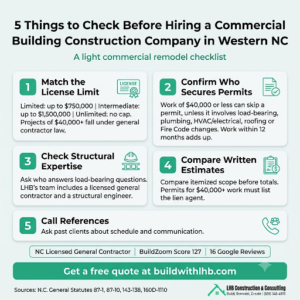
Verify the license limit, the permit path, the structural team, the written estimate, and the references before you sign. Each check protects your budget and your schedule.
How We Chose These Five Checks

We picked checks you can verify yourself, starting with North Carolina’s own statutes.

Four Selection Criteria

  • Each check rests on a state statute or on a decision factor from LHB’s buyer profile.
  • You can verify each check without special tools.
  • Each check protects your budget or your schedule.
  • Each check fits light commercial remodels, the commercial work LHB performs.

Match the Commercial Building Construction Company’s License Limit to Your Project Value

“N.C. General Statutes 87-1 treats anyone who bids on or builds a project costing $40,000 or more as a general contractor.” 

“N.C. General Statutes 87-10 caps a Limited license at $750,000 per project and an Intermediate license at $1,500,000 and sets no cap for an Unlimited license, excluding land and ancillary land-improvement costs.”

So before you compare bids, confirm the contractor’s license class covers your project’s cost.

What It Is and What It Does

Request a license number from each contractor, then enter it in the NC Licensing Board for General Contractors (NCLBGC) license search, which also accepts a qualifier number.

Compare the limit with your project’s value, including every phase. LHB Construction & Consulting is a North Carolina Licensed General Contractor, and you can run the same check on us.

Best for

This check suits owners of light commercial properties whose remodel reaches the statutory threshold.

One Honest Limitation

A license limit shows the size of a project a contractor may handle. It does not show workmanship, so pair it with references and a written estimate.

Confirm Who Secures Permits and Whether the Small-Job Exclusion Applies

Find out who secures the permits before work begins. Add up the whole scope first, because the small-job exclusion has limits.

What It Is and What It Does

“N.C. General Statutes 143-138 excludes commercial work costing $40,000 or less from permits unless it involves load-bearing structures, plumbing design changes, heating, cooling, or electrical changes, non-code materials, added roofing, or Fire Code changes. 

The statute counts all work on the property within 12 consecutive months.”

“N.C. General Statutes 160D-1110 bars anyone from starting construction, alteration, or repair of a building without first securing the required permits, and it requires an architect or engineer seal on plans when state law calls for one.”

LHB brings working knowledge of local building codes and regulations to this step.

Best for

This check suits owners whose remodel comes in phases or touches the structure or building systems.

One Honest Limitation

Your local code office applies these statutes to your property. Confirm the permit path there before design work begins.

Check for Structural Expertise on the Project Team

Find out who answers load-bearing questions and who prepares any sealed drawings. A structural engineer on the team keeps those answers in one place.

What It Is and What It Does

Load-bearing work is one of the triggers that bring a small job back into the permit process, as the statute above shows. A structural engineer on the project team can review those questions before the budget locks.

The LHB team includes a licensed general contractor and a structural engineer with over 30 years of combined experience.

Best for

This check suits owners of older buildings who have framing, floor, or foundation questions before they remodel.

One Honest Limitation

LHB’s confirmed commercial scope is licensed light commercial remodel work. Match your building’s size and use to that scope, and contact us directly if you are unsure.

Compare Written Estimates, Contracts, and Payment Terms

Compare scope line by line before you compare totals. A detailed written estimate shows what each bid includes and what it leaves out.

What It Is and What It Does

Get three things in writing from each bidder: 

  • What the work includes 
  • When you pay
  • When it starts and ends.

“Under N.C. General Statutes 160D-1110, a building permit for work costing $40,000 or more must show the lien agent the owner designates, with exceptions for certain owner-occupied homes.” 

Check how each contractor handles that paperwork.

LHB builds its estimates around detailed cost lists and honest budgeting. A homeowner described the result on a residential project: 

“They stayed on budget, ahead of schedule, and listened to what we needed and wanted. I would absolutely use them again!” (Google review, Erica Farrell)

Best for

This check suits owners comparing two or three written bids for one light commercial remodel who want to see scope, not only totals.

One Honest Limitation

A lower total may leave items out, so read the scope before you read the price.

Ask for Communication Proof and References You Can Call

Call past clients and learn how the contractor communicated. Pick references that match your project type.

What It Is and What It Does

Collect references from each contractor, then ask those clients whether the work stayed on schedule and whether questions got quick answers.

LHB holds a BuildZoom score of 127, which the company cites as top 1% in NC, along with 16 Google reviews. 

One homeowner described trade coordination: “They coordinated carefully with the granite installer, plumber, electrician, and tile guy so that I was only without a sink for a couple of days.” (Google review, Cathy Carter)

Another client wrote, “a builder that has integrity, pays attention to the clients needs, provides honest answers, and happily works with REALTORS” (Google review, Melissa Robison)

Best for

This check suits owners who must keep a business open during construction and need steady updates.

One Honest Limitation

The reviews quoted here come from residential projects. Seek references that match your project type.

Frequently Asked Questions (FAQs)

These answers cover license and permit basics.

Q1. How do I verify a general contractor’s license in North Carolina?

Open the NCLBGC license search and enter the contractor’s license number or qualifier number. Review the full record before you sign, then compare the license limit with your project’s value. Request written confirmation of that limit from the contractor.

Q2. How do I know a contractor’s license limit fits my project?

Each license sets the highest value of a single project its holder may handle, and that value excludes land costs. Look up the license, note the limit, and compare it with your total scope, including every phase. Request written confirmation that it covers your whole project.

Q3. Who secures the building permit on a commercial remodel?

State law bars anyone from starting construction, alteration, or repair of a building without first securing the required permits. Get the applicant’s name in writing, then confirm requirements with your local code office.

Q4. Does LHB Construction & Consulting take on light commercial projects in Western NC?

Yes. LHB offers licensed residential and light commercial construction services from Weaverville, NC, and serves Asheville and surrounding communities.

Your Next Step

Before you sign with any commercial building construction company, look up its license, match the limit to your project’s value, and find out who secures the permits. 

Then collect written estimates from two or three firms and call their references. If your project is a light commercial remodel in Weaverville, Asheville, or elsewhere in Western NC, we would welcome a site walk with you.

Get a free quote for your light commercial remodel at buildwithlhb.com. 

We Help Build Your Lifestyle.
Professional vs. DIY Wood Siding Repair: Which Is Right for Asheville-Area Homeowners?

You found soft, discolored boards on your siding, and now you are weighing two paths. One path costs a weekend and a trip for materials. The other costs a call to a contractor. 

Professional vs. DIY wood siding repair looks like a simple price question, but the true cost depends on what sits behind the boards. This article evaluates both paths for Asheville homeowners so you can decide with confidence. 

The Short verdict: a small, low-stakes repair suits a prepared DIYer, while an unknown water source, older paint, or structural doubt points toward a licensed contractor.

Professional vs DIY Wood Siding Repair at a Glance

DIY repair appears cheaper on day one, but a licensed contractor adds diagnosis and accountability.

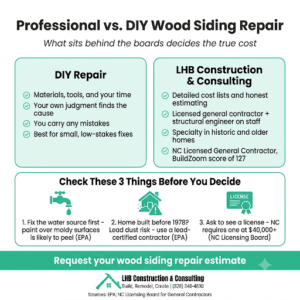
Criterion DIY repair LHB Construction & Consulting
Upfront Outlay Materials, tools, your time Detailed cost lists
Finding the Cause Your own judgment Licensed general contractor and on-staff structural engineer
Older-Home Paint Your own safeguards Specialty in historic and older homes
Cost Transparency Your own tally Honest estimating, realistic budgets
Accountability You carry any mistakes NC Licensed General Contractor, BuildZoom score of 127, cited as top 1% in NC
Communication You manage alone Consistent from planning to final walkthrough

Use the table as a checklist when you compare quotes from any contractor you plan to hire for siding work.

What LHB Construction & Consulting Does Best

Start with the water source, not the boards. 

In its mold cleanup guidance for homes, according to the EPA, “to fix plumbing leaks and other water problems as soon as possible and to dry all items completely.” 

Ask any contractor you consider to trace the cause before replacing boards.

Honest Estimating Before Work Starts

LHB Construction & Consulting provides honest estimating with detailed cost lists, so you see the full scope on paper. That approach speaks directly to the fear of surprise costs. 

Transparency, communication, craftsmanship, and realistic budgeting anchor how the company works. The team guides you from early planning through the final walkthrough. 

One homeowner wrote: “They stayed on budget, ahead of schedule, and listened to what we needed and wanted.” (Erica Farrell, Google review)

Communication matters just as much as the numbers. Another reviewer wrote:

“They were always available to answer any questions” (Jennifer Lynn, Google review).

Structural Insight on Older Homes

Siding damage can point to a larger problem. LHB Construction & Consulting pairs a licensed general contractor with a structural engineer, and the two bring more than 30 years of combined experience. 

This crew also specializes in historic and older homes, including early-1900s craftsman properties, and knows local building codes and regulations.

Its home renovation work includes fixing rotten and underbuilt conditions. Its structural repair work corrects substandard structural systems. 

That combination pairs diagnosis with repair under one roof. Juli, a Google reviewer, wrote: “They are great for work involving older homes requiring some unique solutions.”

Accountability After the Repair

Delise and Bruce Childress own and operate LHB Construction & Consulting, a family-owned, North Carolina Licensed General Contractor. The company holds a BuildZoom score of 127, cited as top 1% in NC, and 16 Google reviews. 

It serves homeowners, homebuyers, sellers, real estate agents, and investors across Western North Carolina. Its work spans home renovations, additions, and property restoration.

Ask to see a license from any contractor you consider, whatever the size of the job. Katie Damien wrote: “These are great builders who stand behind their work.”

What DIY Wood Siding Repair Offers

DIY repair means the homeowner buys the materials, supplies the tools, and does the work personally. They set the schedule, choose the supplies, and decide how to diagnose the damage. 

They pay for materials and skip the contractor’s labor charge. They also arrange any ladders or scaffolding the job needs. They keep the receipts and track the hours themselves. 

They decide when a problem is bigger than expected. They carry the responsibility for every mistake and every redo. DIY suits small, low-stakes tasks for homeowners who have the right tools and the time.

The Key Differences That Matter

The water source and the age of the paint decide the true cost.

Difference 1: Fixing the Moisture Source First

Yes, DIY often looks cheaper upfront, but paint will not hold over mold. 

“If mold has started on your siding, according to EPA, “mold cleanup guidance for homes says not to paint or caulk moldy surfaces, to clean up the mold and dry the surfaces before painting, and warns that paint applied over moldy surfaces is likely to peel.” 

A contractor who traces the water first changes the scope before money goes into paint.

Difference 2: Older-Home Paint and Lead Risk

Yes, you control the work yourself, but older paint adds a hazard that board prices never show. 

According to EPA, “any renovation, repair, or painting project in a pre-1978 home or building that has lead-based paint can easily create dangerous lead dust.” 

According to EPA’s consumer guidance, “homeowners should find an EPA- or state-lead-certified contractor.” 

Ask LHB Construction & Consulting, or any contractor you interview, about lead-safe certification before work starts.

Which Option Is Best for You?

DIY suits hobbyists with the correct tools, time, and risk tolerance for small, low-stakes tasks. 

LHB Construction & Consulting suits Asheville homeowners with older wood-sided homes who want the cause of the damage diagnosed first and detailed cost lists before work starts. 

DIY fits a task where the homeowner already knows the cause. A contractor fits damage with an unknown cause. Neither path fits every house, so match your choice to what you find behind the boards.

Frequently Asked Questions (FAQs)

Settle these questions before you decide.

Q1. What makes the cost to repair wood siding higher than it first looks?

A repair costs more than expected when the water problem behind the damage stays unfixed. EPA’s mold cleanup guidance says to fix plumbing leaks and other water problems as soon as possible and warns that paint applied over moldy surfaces is likely to peel. A detailed cost list shows the scope in full.

Q2. Can I repair rotted wood siding myself?

Small, low-stakes repairs suit a prepared DIYer. If your home predates 1978, read EPA’s lead guidance first. If a leak caused the damage, fix that source first.

Q3. Do I need a licensed contractor to repair wood siding in North Carolina?

“The NC Licensing Board for General Contractors says a general contractor must be licensed if the total project cost is valued at $40,000 or higher.” 

A smaller siding repair may fall below that figure. Even then, ask any contractor to show a license before you sign.

Q4. Should I worry about lead paint when repairing siding on an older Asheville home?

Yes, EPA says any renovation, repair, or painting project in a pre-1978 home or building that has lead-based paint can easily create dangerous lead dust. Ask about lead certification before you hire anyone.

Q5. How does LHB Construction & Consulting estimate a repair job?

LHB Construction & Consulting provides honest estimating with detailed cost lists and realistic budgets. The team guides you from early planning through the final walkthrough.

Conclusion

Whether to repair wood siding yourself or hire a professional depends on what is behind the boards. Find the water source, check your home’s age, and choose the repair that fits what you find.

Ask each contractor you consider for an itemized estimate, a license, and a plan for the water source. If the cause is unclear or your home predates 1978, bring in a licensed professional before you buy materials. 

Request your wood siding repair estimate from LHB Construction & Consulting.

Kitchen Renovation Contractor in Asheville, NC: Run 7 Checks Before You Hire a Licensed Professional

Most Asheville homeowners find out a contractor skipped a step only after the work has started. By then, a missing permit or a vague contract is your problem, not theirs.

Choosing a contractor for kitchen renovation takes more than comparing bids and browsing photos. 

This article gives you 7 checks to run before you sign: 

  • Three on legal standing 
  • Two on contract and payment protection
  • Two on track record and accountability 

Each one draws on North Carolina licensing, permit, and consumer-protection guidance and takes only a few minutes. You will also see how LHB Construction & Consulting, a family-owned Weaverville firm, handles the same questions professionally.

What a Contractor for Kitchen Renovation Handles Beyond Cabinets

A kitchen renovation contractor manages planning, budget, trade coordination, and structural judgment, so hire for all three and not only for finish work.

Core Process: Planning, Budget, Trades, and Structure

A kitchen renovation involves more than cabinets and counters. The contractor plans the scope, sets the budget, and coordinates the trades that touch plumbing, wiring, and finishes. 

LHB Construction & Consulting guides clients from early planning through the final walkthrough, with detailed cost lists, realistic budgets, and consistent communication.

Older Asheville homes add another layer. LHB Construction & Consulting specializes in historic and older homes, including early-1900s craftsman-style properties. The team also includes a structural engineer, and structural renovation work such as framing is part of its experience.

What Buyers Get Wrong When Choosing

The most common mistake is comparing bids on finishes while ignoring the structural work. A kitchen that changes plumbing, wiring, or load-bearing structure also triggers the permit rules. 

Ask every contractor to explain how each part of your scope affects permits before you compare prices.

How to Vet a Contractor for Kitchen Renovation Before You Sign

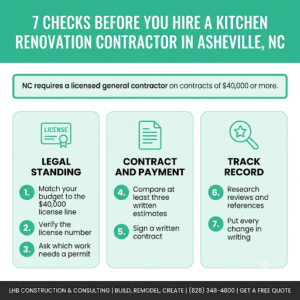
Seven checks that protect you are based on legal standing, contract and payment, and track record and accountability.

  • $40,000 License Rule
  • License Verification
  • Permit Requirements
  • Three Written Estimates
  • Contract and Payment Schedule
  • Reviews and References
  • Changes in Writing

Criterion 1: Legal Standing (Checks 1-3)

Start with the rules that decide whether a contractor can legally take your job.

Match your budget to the $40,000 line. 

“The North Carolina Licensing Board for General Contractors states that a general contractor must be licensed if the contract is valued at $40,000 or higher.” 

A budget at exactly $40,000 falls under that rule. Below it, the license rule does not apply, so ask for proof of qualifications anyway.

Verify the license. The same board page tells homeowners to get proof of licensing and links to the board’s license search. Write down the license number and compare it with the company name on your contract.

Ask which work needs a permit. 

“Under North Carolina General Statute 160D-1110, work costing $40,000 or less in a single-family residence needs no permit under the State Building Code when it follows the code, unless it involves exceptions such as 

  • Load-bearing structures 
  • An added or changed plumbing design 
  • Added or changed heating 
  • Air-conditioning, or electrical wiring and equipment 
  • An added roof
  • Changes covered by the Fire Code.” 

Simple swaps, like replacing one light fixture with another, usually don’t trigger those permit rules.

The board also advises you to contact your local permitting office to find out whether permits are required. Above $40,000, the exemption does not apply.

Criterion 2: Contract and Payment Protection (Checks 4-5)

Next, confirm that the paperwork protects both sides.

Compare at least three written estimates. 

“The North Carolina Department of Justice advises homeowners to get at least three written estimates for the work they want done.” 

Line up the scope in each estimate before you look at the totals.

Sign a written contract and pay as the work progresses. 

“The North Carolina Licensing Board for General Contractors advises a written contract that describes the work, the materials, and the equipment, with a payment schedule and a completion timeline. 

And it says to pay as work is completed, never pay for unfinished work, and never pay in cash.”

Criterion 3: Track Record and Accountability (Checks 6-7)

Finally, look at the contractor’s history and how the contractor handles the agreed terms.

Research the business and its owner. Read recent client reviews, and ask for references from past kitchen projects. 

LHB Construction & Consulting adds Google reviews and a BuildZoom score of 127, a rating the company cites as top 1% in North Carolina.

Put every change in writing. The same licensing board guidance says to note any changes in writing and to understand the contract before you sign it. Treat a contractor who resists written changes as a reason to pause.

How LHB Construction & Consulting Approaches Your Kitchen Renovation

LHB Construction & Consulting plans your kitchen with detailed cost lists and realistic budgets, builds with a licensed general contractor and a structural engineer, and guides you through to the final walkthrough. 

The family-owned team, led by Delise and Bruce Childress, has served Western North Carolina since 1998.

Their Specific Process

LHB Construction & Consulting takes a hands-on approach from early planning to the final walkthrough. Honest estimating, detailed cost lists, and realistic budgets set expectations before the work starts. Consistent communication continues through construction management.

The team includes a North Carolina Licensed General Contractor and a structural engineer, with over 30 years of combined experience. Strong knowledge of local building codes and regulations supports the permit questions in Check 3. 

That combination matters when a kitchen layout change reaches the walls, the floor system, or the plumbing and wiring behind them.

Proof Point: What Clients Report

Cathy Carter wrote in a Google review of her kitchen project: 

“They coordinated carefully with the granite installer, plumber, electrician, and tile guy so that I was only without a sink for a couple of days.“

Every kitchen differs, so your timeline depends on your scope and permits. LHB Construction & Consulting also offers HUD-certified 203(k) consulting for buyers financing a fixer-upper.

Frequently Asked Questions (FAQs)

These answers cover the questions Asheville and Weaverville homeowners ask most before they hire.

Q1. Do I need a licensed contractor for a kitchen remodel in Asheville?

North Carolina requires a general contractor to be licensed when the contract is valued at $40,000 or higher. Below that figure, the state license rule does not apply, but you should still verify credentials and sign a written contract. 

Contact your local permitting office before work starts to confirm which permits your scope needs.

Q2. When does a kitchen renovation in Asheville need a permit?

Work costing $40,000 or less in a single-family residence needs no State Building Code permit when it follows the code, unless it involves exceptions such as load-bearing structures, plumbing design changes, heating, air-conditioning, or electrical wiring changes, an added roof, or Fire Code changes. 

Above $40,000, the exemption does not apply. Your local permitting office confirms what your project needs.

Q3. How do I check a contractor’s license in North Carolina?

Use the license search linked from the North Carolina Licensing Board for General Contractors’ website. Record the license number, and match the name on the license to the name on your contract.

Q4. What does LHB Construction & Consulting bring to a kitchen renovation in Weaverville?

The team brings a licensed general contractor and a structural engineer to the project. You also get detailed cost lists and consistent communication from planning through the final walkthrough.

Q5. How many estimates should I compare for a kitchen renovation?

Compare at least three written estimates. Check that each one lists the same scope, materials, and timeline before you weigh the prices.

Conclusion

The best contractors for kitchen renovation welcome tough questions. They show their license, explain which work needs permits, put the scope and payment schedule in writing, and have a track record you can verify. 

Before you sign, gather written answers from two or three contractors and compare them side by side. The ones who answer openly have earned a closer look.

If you’re ready to start, LHB Construction & Consulting, a family-owned firm in Weaverville, is happy to walk you through your project, your permit questions, and a clear written estimate. 

Contact LHB Construction & Consulting today to plan a kitchen you can trust from the first conversation to the final walkthrough.