Professional vs. DIY Wood Siding Repair: Which Is Right for Asheville-Area Homeowners?
You found soft, discolored boards on your siding, and now you are weighing two paths. One path costs a weekend and a trip for materials. The other costs a call to a contractor.
Professional vs. DIY wood siding repair looks like a simple price question, but the true cost depends on what sits behind the boards. This article evaluates both paths for Asheville homeowners so you can decide with confidence.
The Short verdict: a small, low-stakes repair suits a prepared DIYer, while an unknown water source, older paint, or structural doubt points toward a licensed contractor.
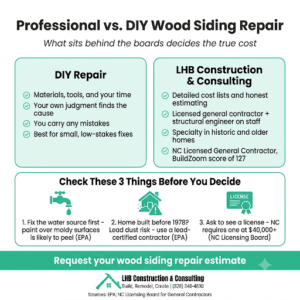
Professional vs DIY Wood Siding Repair at a Glance
DIY repair appears cheaper on day one, but a licensed contractor adds diagnosis and accountability.
| Criterion | DIY repair | LHB Construction & Consulting |
| Upfront Outlay | Materials, tools, your time | Detailed cost lists |
| Finding the Cause | Your own judgment | Licensed general contractor and on-staff structural engineer |
| Older-Home Paint | Your own safeguards | Specialty in historic and older homes |
| Cost Transparency | Your own tally | Honest estimating, realistic budgets |
| Accountability | You carry any mistakes | NC Licensed General Contractor, BuildZoom score of 127, cited as top 1% in NC |
| Communication | You manage alone | Consistent from planning to final walkthrough |
Use the table as a checklist when you compare quotes from any contractor you plan to hire for siding work.
What LHB Construction & Consulting Does Best
Start with the water source, not the boards.
In its mold cleanup guidance for homes, according to the EPA, “to fix plumbing leaks and other water problems as soon as possible and to dry all items completely.”
Ask any contractor you consider to trace the cause before replacing boards.
Honest Estimating Before Work Starts
LHB Construction & Consulting provides honest estimating with detailed cost lists, so you see the full scope on paper. That approach speaks directly to the fear of surprise costs.
Transparency, communication, craftsmanship, and realistic budgeting anchor how the company works. The team guides you from early planning through the final walkthrough.
One homeowner wrote: “They stayed on budget, ahead of schedule, and listened to what we needed and wanted.” (Erica Farrell, Google review)
Communication matters just as much as the numbers. Another reviewer wrote:
“They were always available to answer any questions” (Jennifer Lynn, Google review).
Structural Insight on Older Homes
Siding damage can point to a larger problem. LHB Construction & Consulting pairs a licensed general contractor with a structural engineer, and the two bring more than 30 years of combined experience.
This crew also specializes in historic and older homes, including early-1900s craftsman properties, and knows local building codes and regulations.
Its home renovation work includes fixing rotten and underbuilt conditions. Its structural repair work corrects substandard structural systems.
That combination pairs diagnosis with repair under one roof. Juli, a Google reviewer, wrote: “They are great for work involving older homes requiring some unique solutions.”
Accountability After the Repair
Delise and Bruce Childress own and operate LHB Construction & Consulting, a family-owned, North Carolina Licensed General Contractor. The company holds a BuildZoom score of 127, cited as top 1% in NC, and 16 Google reviews.
It serves homeowners, homebuyers, sellers, real estate agents, and investors across Western North Carolina. Its work spans home renovations, additions, and property restoration.
Ask to see a license from any contractor you consider, whatever the size of the job. Katie Damien wrote: “These are great builders who stand behind their work.”
What DIY Wood Siding Repair Offers
DIY repair means the homeowner buys the materials, supplies the tools, and does the work personally. They set the schedule, choose the supplies, and decide how to diagnose the damage.
They pay for materials and skip the contractor’s labor charge. They also arrange any ladders or scaffolding the job needs. They keep the receipts and track the hours themselves.
They decide when a problem is bigger than expected. They carry the responsibility for every mistake and every redo. DIY suits small, low-stakes tasks for homeowners who have the right tools and the time.
The Key Differences That Matter
The water source and the age of the paint decide the true cost.
Difference 1: Fixing the Moisture Source First
Yes, DIY often looks cheaper upfront, but paint will not hold over mold.
“If mold has started on your siding, according to EPA, “mold cleanup guidance for homes says not to paint or caulk moldy surfaces, to clean up the mold and dry the surfaces before painting, and warns that paint applied over moldy surfaces is likely to peel.”
A contractor who traces the water first changes the scope before money goes into paint.
Difference 2: Older-Home Paint and Lead Risk
Yes, you control the work yourself, but older paint adds a hazard that board prices never show.
According to EPA, “any renovation, repair, or painting project in a pre-1978 home or building that has lead-based paint can easily create dangerous lead dust.”
According to EPA’s consumer guidance, “homeowners should find an EPA- or state-lead-certified contractor.”
Ask LHB Construction & Consulting, or any contractor you interview, about lead-safe certification before work starts.
Which Option Is Best for You?
DIY suits hobbyists with the correct tools, time, and risk tolerance for small, low-stakes tasks.
LHB Construction & Consulting suits Asheville homeowners with older wood-sided homes who want the cause of the damage diagnosed first and detailed cost lists before work starts.
DIY fits a task where the homeowner already knows the cause. A contractor fits damage with an unknown cause. Neither path fits every house, so match your choice to what you find behind the boards.
Frequently Asked Questions (FAQs)
Settle these questions before you decide.
Q1. What makes the cost to repair wood siding higher than it first looks?
A repair costs more than expected when the water problem behind the damage stays unfixed. EPA’s mold cleanup guidance says to fix plumbing leaks and other water problems as soon as possible and warns that paint applied over moldy surfaces is likely to peel. A detailed cost list shows the scope in full.
Q2. Can I repair rotted wood siding myself?
Small, low-stakes repairs suit a prepared DIYer. If your home predates 1978, read EPA’s lead guidance first. If a leak caused the damage, fix that source first.
Q3. Do I need a licensed contractor to repair wood siding in North Carolina?
“The NC Licensing Board for General Contractors says a general contractor must be licensed if the total project cost is valued at $40,000 or higher.”
A smaller siding repair may fall below that figure. Even then, ask any contractor to show a license before you sign.
Q4. Should I worry about lead paint when repairing siding on an older Asheville home?
Yes, EPA says any renovation, repair, or painting project in a pre-1978 home or building that has lead-based paint can easily create dangerous lead dust. Ask about lead certification before you hire anyone.
Q5. How does LHB Construction & Consulting estimate a repair job?
LHB Construction & Consulting provides honest estimating with detailed cost lists and realistic budgets. The team guides you from early planning through the final walkthrough.
Conclusion
Whether to repair wood siding yourself or hire a professional depends on what is behind the boards. Find the water source, check your home’s age, and choose the repair that fits what you find.
Ask each contractor you consider for an itemized estimate, a license, and a plan for the water source. If the cause is unclear or your home predates 1978, bring in a licensed professional before you buy materials.
Request your wood siding repair estimate from LHB Construction & Consulting.