Custom Home Builder vs. Separate Architect and General Contractor in Asheville, NC
When you search for custom home building help, you get different answers. One professional may suggest hiring an architect first.
Another may suggest a builder-led team. Both paths can work, but confusion grows when no one explains who handles the decisions that connect plans, pricing, and construction.
Homeowners comparing custom home builders in Asheville, NC, should focus on accountability, not labels alone.
You need to know who answers questions, approves price changes, coordinates technical input, and communicates with you once the plans reach construction.
A separate architect and general contractor may suit buyers who want independently selected professionals. A builder-led path may suit buyers who want a central construction team.
The right choice depends on your preferred involvement, the written agreements, and how clearly the team assigns responsibility.
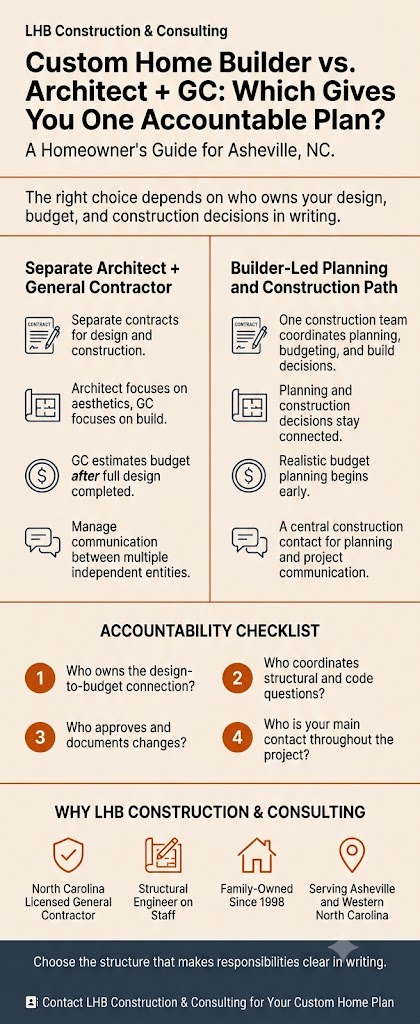
Quick Comparison: Builder-Led Path vs. Separate Architect and General Contractor
A clear written scope matters more than the project label. Compare each option by who owns decisions, updates the budget, documents changes, and communicates with you.
| Decision factor | Separate architect + general contractor | Builder-led planning and construction path | What to confirm |
| Contract structure | Separate agreements can define separate scopes. | A central process can coordinate construction planning and delivery. | Which services appear in writing? |
| Design decisions | The architect’s agreement should define design and construction administration. | The team should explain how design services are provided or coordinated. | Who approves and records revisions? |
| Budget updates | You need to confirm who the prices plan or selection changes are for. | You need to confirm how estimates change with scope. | When will you receive the cost impact? |
| Construction administration | Ask whether the architect provides this service. | Ask how construction-stage questions and records are handled. | Who manages project decisions? |
| Contractor administration | The GC manages construction duties under its agreement. | The construction team should define comparable duties. | Who manages trades, schedules, and site access? |
| Communication | You need a documented communication chain. | You need a main contact and escalation path. | Who answers questions that affect cost or construction? |
“The North Carolina Board of Architecture and Registered Interior Designers Design/Build Guidelines state that design-build arrangements need clear written disclosure of roles, responsibilities, contracts, communication, accounting, and project changes.”
What LHB Construction & Consulting Does Best
LHB Construction & Consulting may be a better fit if you want licensed-GC oversight, custom-home planning, realistic budgeting, construction management, and structural support when your project requires it.
The company helps homeowners move from early planning into construction with a defined process for decisions, costs, and communication.
●Custom-Home Planning With Construction Input From the Start
LHB plans and builds custom homes from the ground up. Early planning gives you time to discuss layout, lifestyle needs, budget range, construction priorities, and site questions before work begins.
That conversation matters because a design choice can affect framing, foundations, material selections, trade scheduling, and the working budget. Ask how the team will review those effects before you approve a revision.
Katie Damien wrote in a Google review, “Bruce and Delise helped me build the home of my dreams!”
She added that LHB built her home “from scratch on raw land” after she brought an original design with “custom architecture and unique features.”
That client experience illustrates the value of connecting a custom concept with real construction planning.
●Licensed GC Oversight and Structural Support for Complex Decisions
LHB Construction & Consulting is a North Carolina Licensed General Contractor, and its team includes a structural engineer.
That combination can matter when a custom-home project raises questions about foundations, framing, structural conditions, or other technical construction details.
Not every new home requires the same level of structural input. Your project needs a team that can identify when specialized input is appropriate and explain how that decision affects scope, budget, and construction planning.
“The North Carolina Licensing Board for General Contractors identifies residential contractor work as construction activity involving residential units that must comply with the state’s residential building code.”
Ask every prospective builder to explain its license classification, construction role, and process for coordinating technical requirements.
●Budgeting, Construction Management, and Consistent Communication
LHB provides project planning, detailed cost lists, realistic budgeting, construction management, and consistent communication. This approach gives homeowners a practical way to discuss costs before a selection, scope revision, or construction question affects the project.
You should receive a direct answer when a decision affects price or timing. You should also know who records the decision and who communicates it to the people doing the work.
Cathy Carter wrote that Bruce and Delise “coordinated carefully with the granite installer, plumber, electrician, and tile guy.”
Erica Farrell wrote, “They stayed on budget, ahead of schedule, and listened to what we needed and wanted.”
These are individual client experiences, not promises for every project, but they show the coordination and communication buyers should evaluate.
What Separate Architect and General Contractor Arrangements Offer
Separate architect and general contractor agreements may work well for homeowners who want to independently choose each professional. This structure can give you direct control over who designs the home and who manages construction.
You need to confirm how the two parties will coordinate design development, construction administration, pricing, schedule changes, and homeowner communication.
“The North Carolina Board of Architecture and Registered Interior Designers Construction Administration Guidelines distinguish architect construction-administration activities from contractor responsibilities such as change-order costs, schedule adherence, site access, and site safety.”
The Key Differences That Matter Before You Hire
The key difference is not whether your project includes an architect, engineer, or general contractor. The key difference is whether you can identify, in writing, who handles connected decisions that affect design, price, timing, and construction work.
●Independent Choice vs. Central Construction Coordination
Yes, separate contracts can give you more independence when selecting professionals. But you should confirm how independently retained parties will coordinate when a design decision affects the construction budget or schedule.
A builder-led path may be better suited to buyers who want a central construction contact. That structure still needs written responsibilities. The project label alone does not tell you who owns the next decision.
●Separate Service Scopes vs. One Documented Accountability Structure
Yes, separate agreements can clearly define specialized services. But your team should also define what happens between those scopes, especially when plans change, a construction question arises, or a cost update is needed.
A builder-led team can provide a central coordination structure for planning and construction. It does not automatically remove every change or concern. Written responsibilities, documented approvals, and a reliable communication process determine whether the homeowner receives an accountable plan.
Accountability Before You Sign: The Custom Home Decision Checklist
Before choosing custom home builders in Asheville, NC, ask who owns every decision that connects plans, pricing, technical requirements, construction changes, and communication. This checklist helps you compare providers on the issues that matter after the initial design conversation.
●Who Owns the Design-to-Budget Connection?
Ask: “When the plan, specification, or material selection changes, who prepares the revised cost impact, and when will I receive it?”
Your agreement should identify who compares plans and selections against the working construction budget. LHB’s planning and budgeting services include detailed cost lists and realistic estimates, which can help homeowners discuss changes before work proceeds.
●Who Coordinates Structural, Code, and Constructability Questions?
Ask: “If a technical or structural question changes the construction approach, who coordinates the right licensed professional and explains the impact?”
The answer depends on your home, site, and written agreements. LHB’s licensed-GC and structural-engineer resources may fit buyers who want construction and structural considerations discussed within the same planning process.
●Who Approves and Documents Changes That Affect Cost or Schedule?
Ask: “Will I receive the cost and schedule effect before I approve a change?”
Request a written process for plan revisions, allowances, materials, added work, and homeowner approvals.
“The North Carolina Board of Architecture and Registered Interior Designers Design/Build Guidelines address written disclosure of roles, responsibilities, contracts, communication, accounting, and changes in a design-build arrangement.”
●Who Is the Main Contact From Early Planning Through Final Walkthrough?
Ask: “Who will answer my question if it affects design, price, schedule, or construction?”
Confirm update frequency, meeting expectations, decision documentation, and escalation steps before you sign.
LHB describes a hands-on process from early planning through final walkthrough, which may suit homeowners who want a consistent construction-management process.
Which Option Is Best for You?
Choose the project structure that fits your preferred level of control and your willingness to coordinate separate professionals.
| Best fit | Buyer Situation |
| Separate architect + general contractor | You want separate contracts and active involvement in coordinating independently selected professionals. |
| Builder-led planning and construction path | You want a central construction team to coordinate planning, budgeting, construction management, and communication. |
| LHB Construction & Consulting | You want Asheville-area custom-home planning and construction with licensed-GC oversight, structural-engineer support, realistic budgeting, and hands-on project guidance. |
Separate architect and GC agreements are best for homeowners who want independent professional relationships and are prepared to define every handoff in writing.
LHB Construction & Consulting may be best suited to homeowners who want a family-owned construction team to guide planning, budgeting, custom-home construction, and project communication.
Frequently Asked Questions (FAQs)
●Do I need both an architect and a general contractor to build a custom home in Asheville?
The answer depends on the home’s design, project requirements, local approvals, and services included in each agreement.
“The North Carolina Board of Architecture and Registered Interior Designers Design/Build Guidelines describe the importance of identifying the licensed professionals involved and clearly disclosing their project responsibilities.”
Before you hire a team, ask who will coordinate the work.
●What is the difference between an architect and a general contractor?
An architect’s scope can include design and defined construction-administration services.
“The North Carolina Board of Architecture and Registered Interior Designers Construction Administration Guidelines distinguish those services from contractor duties that can include change-order costs, schedule adherence, site access, and site safety.”
Ask both parties to explain their written scope before you sign.
●Can a custom home builder help me plan my home before construction starts?
Some builders provide planning, estimating, budgeting, and construction-management support before construction begins.
LHB Construction & Consulting offers custom-home planning and construction, project budgeting, construction management, and guidance from early planning through final walkthrough.
●What should I ask before hiring a custom home builder in Asheville?
Ask who manages design coordination, budget updates, structural questions, change approvals, schedules, subcontractor coordination, and homeowner communication. Request written answers that match the proposed contracts and project process.
Choose the Project Structure That Makes Responsibilities Clear
Do not choose a project path only because it is called architect-led, builder-led, or design-build.
Choose the structure that clearly documents who owns the design decisions, budget updates, technical coordination, construction changes, and communication with you.
When comparing custom home builders in Asheville, NC, homeowners should prioritize written roles, appropriate licensed-professional involvement, practical budgeting, and a communication process that fits their needs.
Contact LHB Construction & Consulting to discuss your custom-home plans in Asheville or Western North Carolina, including planning needs, budget questions, structural considerations, and construction-management support.